Theseus and the Minotaur: The Myth of the Labyrinth
Published: 8/26/2026
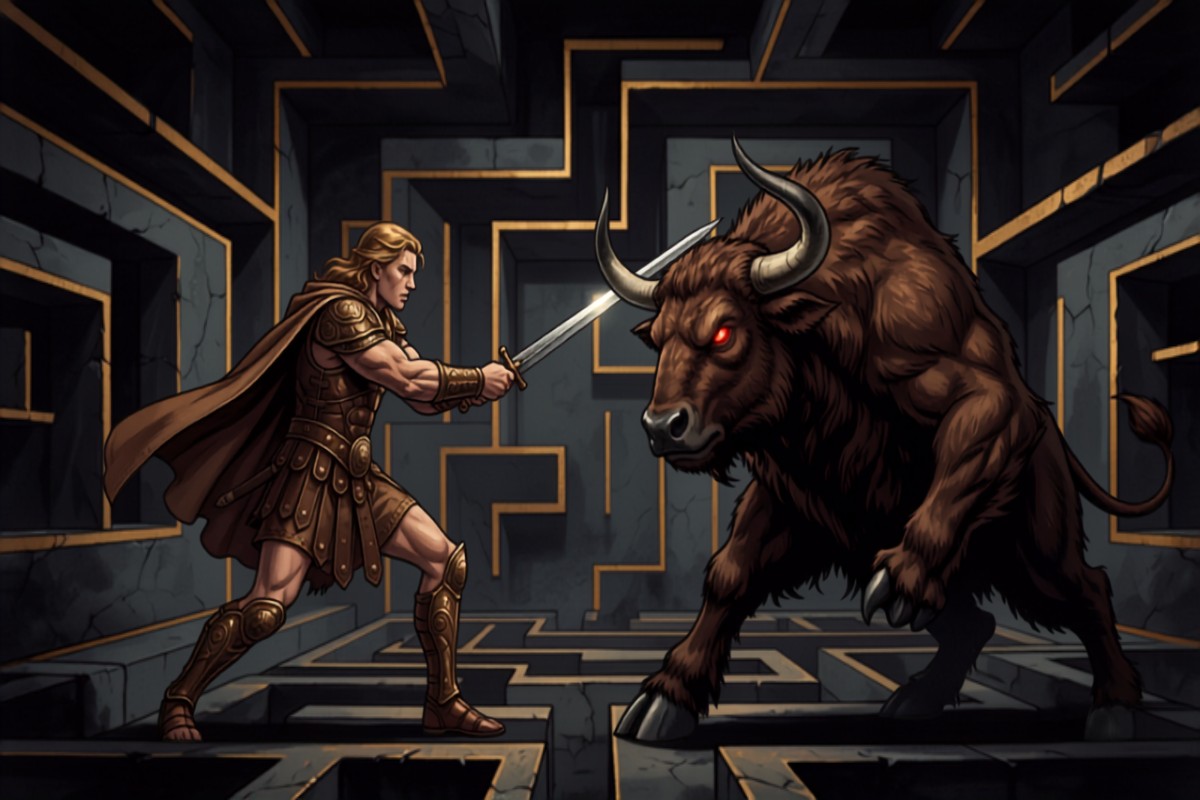
Quick answer: Theseus was an Athenian hero, son of King Aegeus (or, in another version, the god Poseidon), famed for defeating the monstrous Minotaur inside the Cretan labyrinth. With the help of Ariadne's thread, he found his way out of Daedalus's maze and freed Athens from a terrible tribute.
A hero of double parentage
According to myth, Theseus was born from an unusual set of circumstances. King Aegeus of Athens, lacking an heir, consulted an oracle and received a cryptic prophecy. On his way home he stopped in Troezen, where he spent a night with princess Aethra. In some versions of the myth, the sea god Poseidon united with Aethra that same night, making Theseus simultaneously the son of a mortal king and the offspring of an Olympian. Aegeus hid a sword and sandals beneath a heavy boulder, instructing Aethra to send their son to Athens once he grew strong enough to move the stone.
The road to Athens and six labors
Once grown, Theseus lifted the boulder, retrieved his father's relics, and instead of the safer sea route chose the dangerous overland road infested with bandits. Along the way he defeated six villains: Periphetes with his bronze club, the bandit Sinis, the ferocious Crommyonian Sow, Sciron who threw travelers off cliffs, the wrestler Cercyon, and Procrustes with his infamous bed. Each victory added to his fame, and by the time he reached Athens he was already celebrated as a champion of justice.
The tribute to Crete and the beast in the labyrinth
At that time Athens paid a terrible tribute to King Minos of Crete: every nine years the city sent seven young men and seven young women to be devoured by the Minotaur, a creature with a man's body and a bull's head, born from an unnatural union between Minos's wife Pasiphae and a sacred bull. The monster was kept inside a labyrinth built by the brilliant craftsman Daedalus — a structure so intricate that escaping it was considered nearly impossible. Theseus volunteered to join the group of victims, determined to end this humiliation of Athens once and for all.
Ariadne's thread
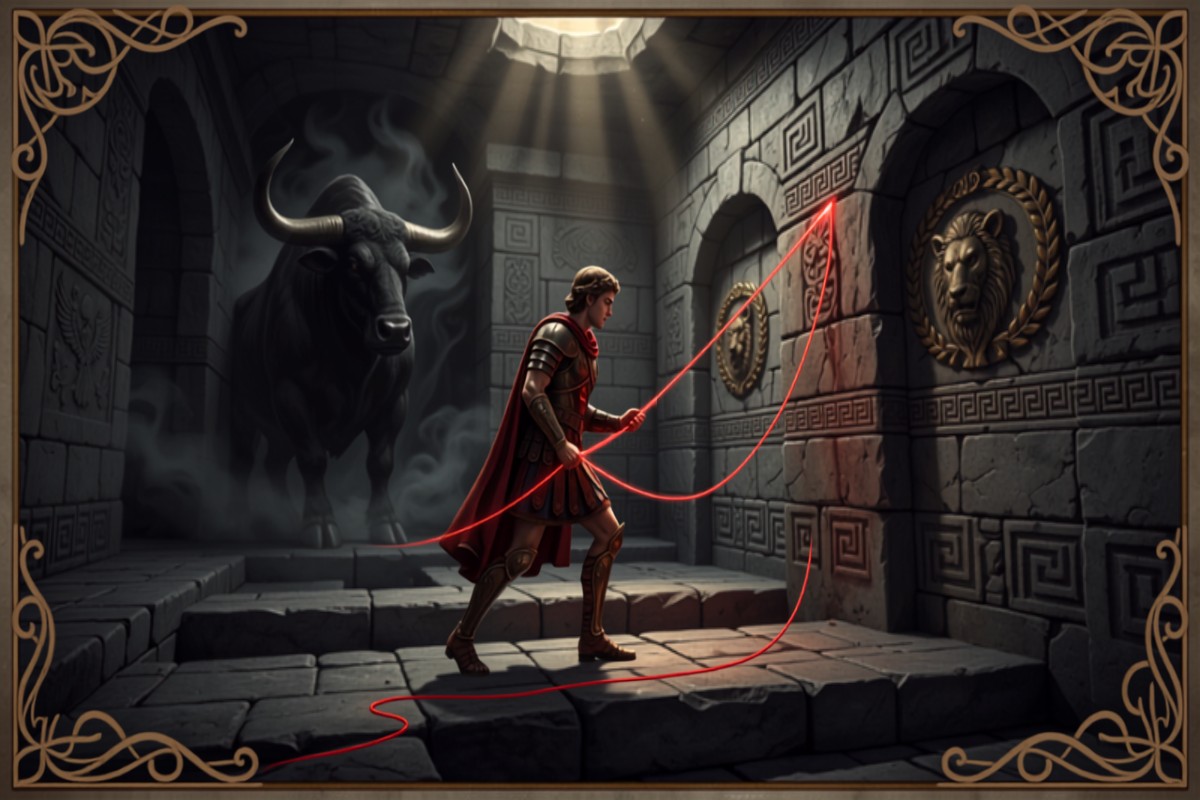
On Crete, princess Ariadne, daughter of Minos, fell in love with Theseus. She secretly gave him a ball of thread and, consulting with Daedalus, devised a plan: tie one end at the entrance and unwind the thread while moving deeper into the maze, so as to retrace the path afterward. Theseus reached the heart of the labyrinth, confronted the Minotaur, and after a fierce struggle killed the beast with his bare hands or with his father's sword, depending on the version. Following the thread back, he and the other Athenian youths safely escaped.
The return and a fatal mistake
Theseus sailed from Crete taking Ariadne with him, but according to the most common version he left her sleeping on the island of Naxos — whether through forgetfulness or by divine will, since Ariadne was destined to marry Dionysus. Before departing for Crete, Theseus had promised his father that if he succeeded he would replace the ship's black sails with white ones. In the chaos of the return voyage, however, he forgot to fulfill this promise. Seeing the black sails on the horizon, Aegeus assumed his son had died and threw himself into the sea, which has been called the Aegean ever since.
Kingship and legacy
Once he ascended the Athenian throne, Theseus became famous not only for his martial feats but also for his statesmanship. Tradition credits him with uniting the scattered settlements of Attica into a single city-state centered on Athens — a process known as synoikismos. He is said to have introduced common laws, established festivals, and laid the foundations of Athenian civic identity, earning him a place among the city's founding figures alongside later reformers.
Theseus in culture and art
The myth of Theseus and the Minotaur became one of the most recognizable stories in Western culture. The image of a hero navigating a maze with a thread in hand became a universal metaphor for overcoming complex, tangled obstacles — hence the expression "Ariadne's thread," meaning a saving clue in a difficult situation. The story inspired ancient vase painters and Renaissance artists, and in the twentieth and twenty-first centuries it became source material for video games, novels, and films, where the labyrinth and the monster are reinterpreted as symbols of inner fears and the trials of growing up.
Frequently asked questions
Was Aegeus or Poseidon the father of Theseus?
The myth deliberately preserves this ambiguity: Theseus was considered simultaneously the son of the mortal king Aegeus and of the god Poseidon, underscoring his exceptional destiny and his ties to both the human and divine worlds.
Why did Ariadne's thread become a symbol?
The thread allowed Theseus to avoid getting lost inside Daedalus's intricate labyrinth, and ever since, the phrase "Ariadne's thread" has been used to describe any clue or method that helps someone find a way out of a complicated, confusing situation.
What happened to Ariadne after Theseus abandoned her?
In the best-known version of the myth, the sleeping Ariadne was found on Naxos by the wine god Dionysus, who fell in love with her, married her, and granted her immortality.
How did King Aegeus die?
Theseus forgot to change the ship's black sails to white as agreed in the event of victory. Seeing the black sails, Aegeus concluded his son had perished and threw himself into the sea, which has borne his name — the Aegean Sea — ever since.
Similar articles
Ladon: The Hundred-Headed Dragon of the Golden Apples
Ladon is a hundred-headed dragon of Greek mythology who guarded the golden apples of the Hesperides, slain by Heracles during his eleventh labor.
Fafnir: The Dwarf Who Became a Dragon
Fafnir is a figure of Germanic-Norse mythology who transformed into a dragon because of cursed gold and was slain by the hero Sigurd.
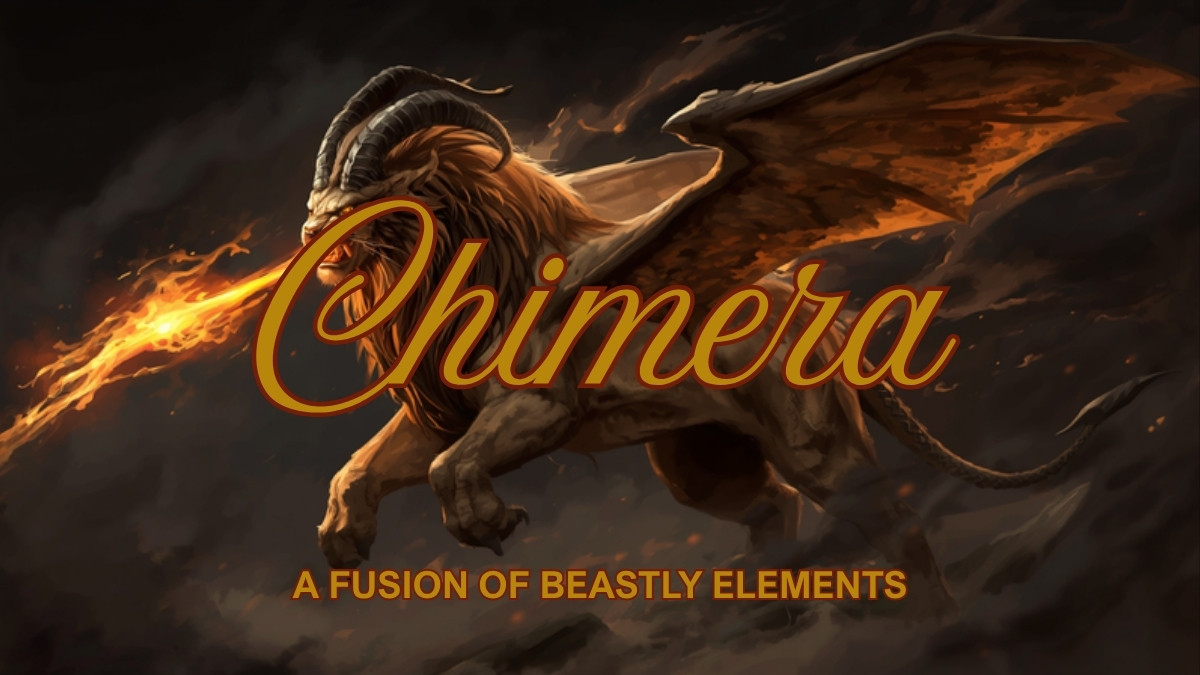
The Chimera: Monster of Lion, Goat, and Serpent
The Chimera is a fire-breathing monster of Greek mythology with a lion's body, a goat's head on its back, and a serpent tail, defeated by the hero Bellerophon.