Ladon: The Hundred-Headed Dragon of the Golden Apples
Published: 8/26/2026
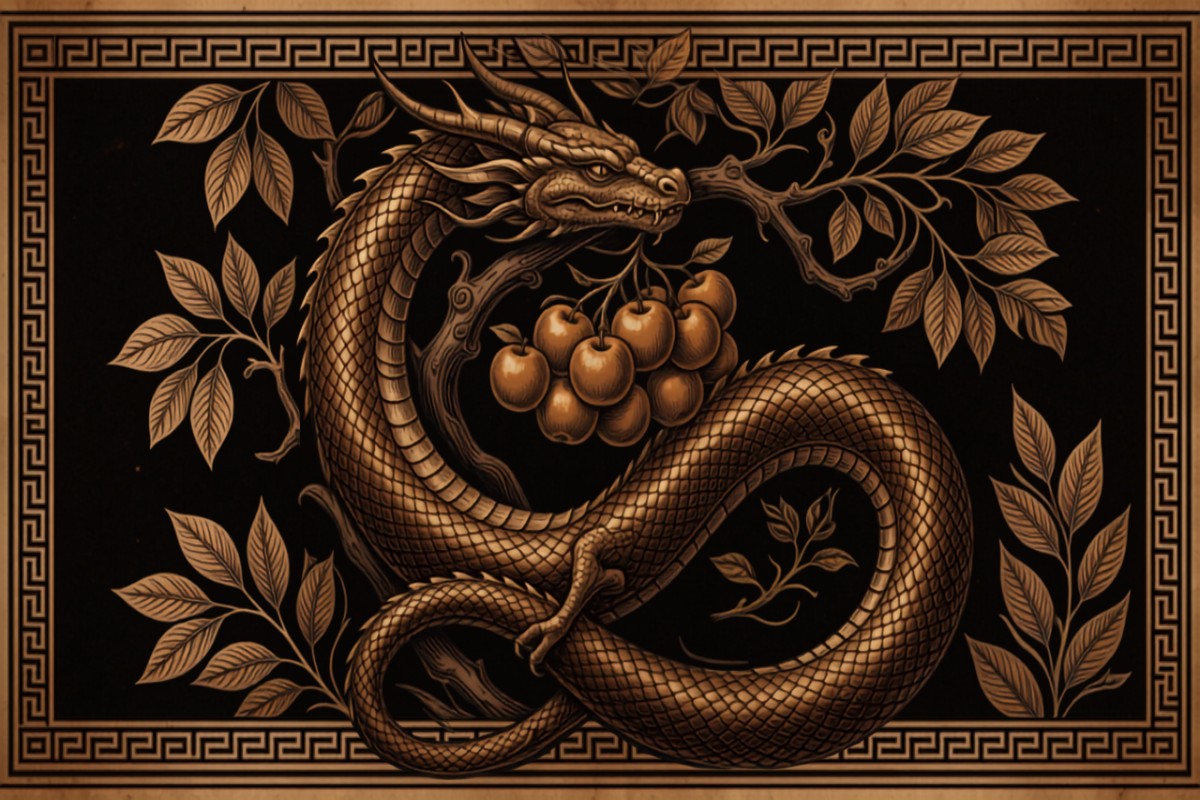
Quick answer: Ladon is a monstrous multi-headed dragon of Greek mythology who guarded the sacred tree bearing golden apples in the garden of the Hesperides at the edge of the world. He was defeated by the hero Heracles during his eleventh labor, undertaken to fetch the apples on the orders of King Eurystheus.
Origins of the monstrous guardian
Ancient sources disagree on Ladon's origins: some call him the son of Typhon and Echidna, making him a sibling of the Chimera, Cerberus, and the Lernaean Hydra, while others consider him the offspring of the earth goddess Gaia or the sea deities Phorcys and Ceto. The number of the dragon's heads also varies across sources — from one to a hundred, though the most widespread tradition depicts Ladon as a hundred-headed serpent capable of speaking with many different voices simultaneously, making him a particularly terrifying and ever-vigilant guardian.
The garden of the Hesperides and the golden apples
Ladon guarded a tree bearing golden apples that grew in the mythical garden of the Hesperides, located at the very edge of the known world, often placed by ancient authors somewhere in North Africa or near Mount Atlas. The tree itself was a wedding gift from the earth goddess Gaia to the goddess Hera on her marriage to Zeus, and the apples possessed the power to grant immortality to whoever ate them, which made guarding the tree such a critically important task.
Heracles's eleventh labor
King Eurystheus, wishing to make Heracles's already difficult trials even harder, ordered him to fetch the golden apples from the garden of the Hesperides — a task made harder not only by the presence of a vigilant dragon but also by the fact that the hero himself did not know the garden's exact location. According to the most widespread version of the myth, Heracles first freed the Titan Prometheus, chained to a rock, from the eagle that tormented him, and the grateful Titan, in gratitude, showed the hero the correct path to his goal.
The trick with Atlas
Arriving at the edges of the garden, Heracles met the Titan Atlas, who held the vault of heaven upon his shoulders, and struck a cunning deal with him: the hero temporarily took on the unbearable burden of the sky while Atlas, as father of the Hesperides, went to pick the apples himself, bypassing the dragon Ladon, whom the Titan trusted more. Returning with the apples, Atlas, having tasted freedom from his eternal burden, tried to trick Heracles by refusing to take back the sky, offering instead to deliver the apples to the king himself. However, the resourceful Heracles, feigning agreement, asked Atlas to hold the sky just a moment longer so he could adjust a cushion under his shoulders — and as soon as the Titan took the burden back, Heracles grabbed the apples and hurried away.
An alternative version: direct slaying of the dragon
There is also another, less common version of the myth, according to which Heracles himself entered the garden and killed the hundred-headed Ladon with an arrow shot from his bow, after which he personally picked the apples from the tree. This version is supported by some ancient vase depictions showing Heracles fighting directly with a multi-headed serpent coiled around the tree's trunk.
Ladon's fate and the constellation Draco
According to one tradition, after the faithful guardian's death, the grieving Hesperid sisters mourned Ladon so bitterly that their tears turned into amber, and the goddess Hera herself, wishing to honor the devoted protector of her tree, raised the dragon's image to the heavens, placing it among the stars as the constellation Draco, winding between the Great and Little Bears near the celestial North Pole.
The legacy of the myth
The story of Ladon became a classic example of the "treasure-guarding dragon" archetype, influencing countless later legends and works — from the Germanic Fafnir to dragons of modern fantasy. The motif of stealing the fruit of immortality from a vigilant, multi-headed guardian also echoes mythological stories from other cultures, where a hero confronts a serpent-like being defending a source of eternal life or supreme knowledge.
Frequently asked questions
How many heads did the dragon Ladon have?
The number of heads varies across sources — from one to a hundred, though the best-known tradition depicts Ladon specifically as a hundred-headed dragon capable of producing many different voices simultaneously.
How did Heracles obtain the apples without fighting the dragon?
In one version of the myth, Heracles struck a deal with the Titan Atlas: he temporarily held the vault of heaven on his shoulders while Atlas himself gathered the apples, bypassing the dragon, which trusted him as the Hesperides' father.
What happened to Ladon after Heracles took the apples?
The dragon's fate differs across myths: in one version he was killed by Heracles with an arrow, in another he was simply bypassed thanks to the trick with Atlas; a separate tradition holds that after his death Hera raised his image to the sky as the constellation Draco.
Similar articles
Fafnir: The Dwarf Who Became a Dragon
Fafnir is a figure of Germanic-Norse mythology who transformed into a dragon because of cursed gold and was slain by the hero Sigurd.

The Chimera: Monster of Lion, Goat, and Serpent
The Chimera is a fire-breathing monster of Greek mythology with a lion's body, a goat's head on its back, and a serpent tail, defeated by the hero Bellerophon.

Sirens: The Song That Doomed Sailors
Sirens are mythical creatures of Greek mythology whose song lured sailors to deadly rocks. The history of the image, from bird-women to mermaids.