Fafnir: The Dwarf Who Became a Dragon
Published: 8/26/2026
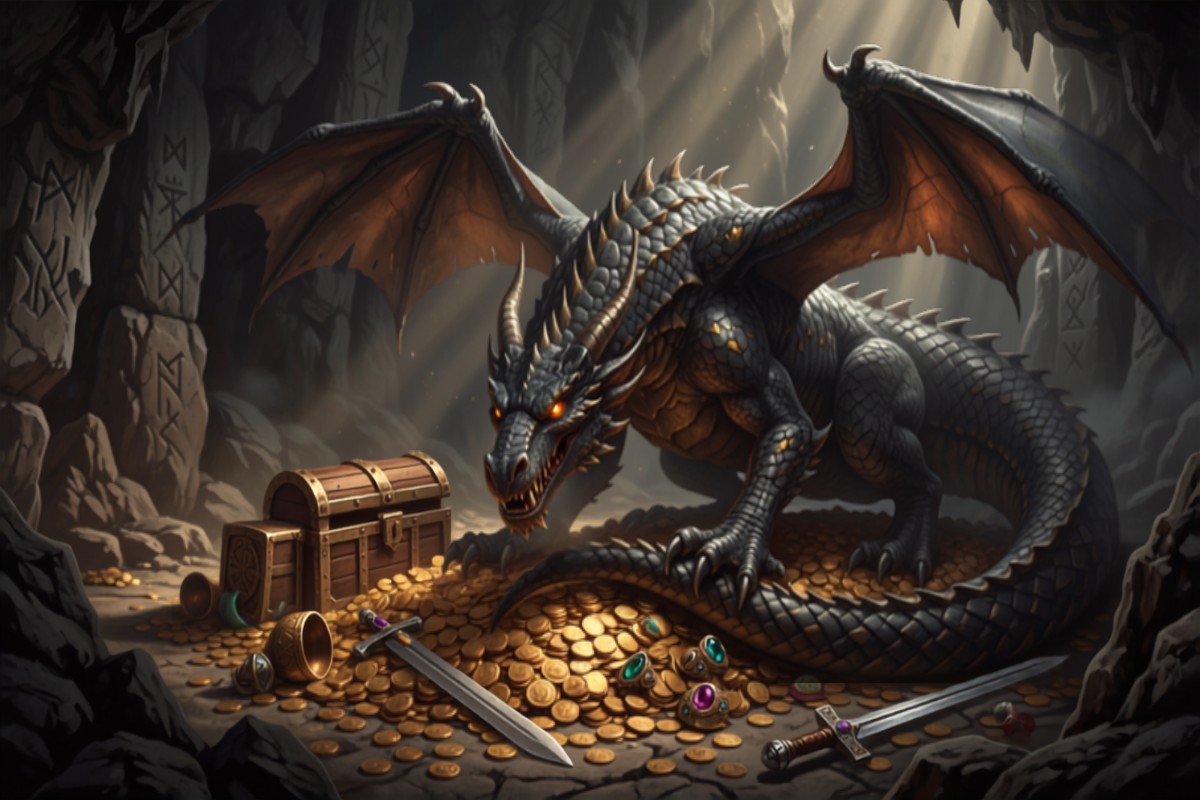
Quick answer: Fafnir is a figure from Germanic-Norse mythology, originally a dwarf who, driven by greed for the cursed gold of the god Loki, transformed into a monstrous dragon. For many years he guarded a treasure in his lair, until he was killed by the hero Sigurd, who pierced him from below with the sword Gram.
Andvari's cursed gold
The story begins when the god Loki carelessly killed an otter that was actually a shapeshifter — the son of the dwarf Hreidmar, named Otr. As compensation for the killing, Loki was required to fill the otter's skin with gold, for which he seized treasure from the dwarf Andvari, including the magical ring Andvaranaut. Enraged, Andvari cursed the ring, prophesying that it would bring ruin to every owner it had.
Patricide and transformation into a dragon
Having received the cursed gold, Hreidmar refused to share it with his sons Fafnir and Regin. Consumed by greed, Fafnir killed his own father to claim the entire treasure for himself, then drove out his brother Regin. Fearing that someone would take the gold from him, Fafnir withdrew to the wasteland of Gnitaheid, where, under the influence of the curse and his own avarice, he gradually transformed into a monstrous serpent-dragon that lay coiled to guard the hoard.
Regin and the raising of Sigurd
The exiled brother Regin became a skilled smith and, harboring a thirst for revenge and a desire to reclaim his share of the treasure, took in and raised the young hero Sigurd, a descendant of the famous Volsung lineage. Regin reforged the fragments of the legendary sword of Sigurd's father Sigmund, creating the formidable blade Gram, capable of cleaving an anvil, and incited the youth to kill the dragon Fafnir, concealing from him the true, self-serving nature of his motives.
The trick with the pit
On the advice of a one-eyed wanderer — actually the god Odin in disguise — Sigurd did not fight the dragon face to face, which would have been suicidal given Fafnir's enormous size and armored hide. Instead, he dug a pit along the path the dragon regularly crawled to drink water, hid inside it, and as the monster crawled overhead, delivered a fatal blow with the sword Gram upward into the dragon's belly, striking its one vulnerable spot unprotected by scales.
The dying conversation and the dragon's blood
The dying Fafnir, briefly regaining partial human reason, engaged Sigurd in a long conversation, warning the hero about the curse of the gold and about Regin's impending betrayal, since Regin would surely try to kill him too in order to claim the treasure alone. Indeed, Regin ordered Sigurd to roast the dragon's heart for him, but while cooking it the hero burned his finger and, instinctively licking it, accidentally tasted the dragon's blood, which suddenly granted him the ability to understand the language of birds. The birds warned Sigurd of Regin's plot, and the hero killed his mentor before he could carry out the betrayal.
The legacy of the Fafnir myth
The story of Fafnir and Sigurd survives in the Icelandic Volsunga Saga and in the Poetic Edda, and it also formed the basis of the German Nibelungenlied, where Sigurd is known as Siegfried. The motif of cursed gold turning a greedy owner into a monster, and a hero slaying a dragon through cunning from below, became a classic narrative archetype that influenced countless later works of fantasy.
Influence on modern culture
Richard Wagner used the Fafnir myth in his opera cycle The Ring of the Nibelung, where the dragon is one of the key characters guarding the cursed gold of the Rhine. J.R.R. Tolkien, who studied Norse and Germanic mythology deeply, explicitly referenced the image of Fafnir when creating his dragon Smaug, and the motif of a dragon's vulnerable belly became one of the most enduring tropes of the fantasy genre and video games.
Frequently asked questions
Who was Fafnir before becoming a dragon?
Fafnir was originally a dwarf, son of Hreidmar, with a human form; he gradually transformed into a dragon due to his own greed and the curse placed on the gold by the dwarf Andvari.
How did Sigurd kill Fafnir?
Following Odin's advice, Sigurd dug a pit along the dragon's path to its watering hole, hid inside it, and as Fafnir crawled overhead, pierced its scale-free belly from below with the sword Gram.
Why did Sigurd start understanding the language of birds?
While roasting the dragon's heart for Regin, Sigurd accidentally burned his finger, instinctively licked it, and thereby tasted Fafnir's blood, which magically granted him the ability to understand the speech of birds, who warned him of Regin's betrayal.
Similar articles
Ladon: The Hundred-Headed Dragon of the Golden Apples
Ladon is a hundred-headed dragon of Greek mythology who guarded the golden apples of the Hesperides, slain by Heracles during his eleventh labor.

The Chimera: Monster of Lion, Goat, and Serpent
The Chimera is a fire-breathing monster of Greek mythology with a lion's body, a goat's head on its back, and a serpent tail, defeated by the hero Bellerophon.

Sirens: The Song That Doomed Sailors
Sirens are mythical creatures of Greek mythology whose song lured sailors to deadly rocks. The history of the image, from bird-women to mermaids.