Sirens: The Song That Doomed Sailors
Published: 8/26/2026
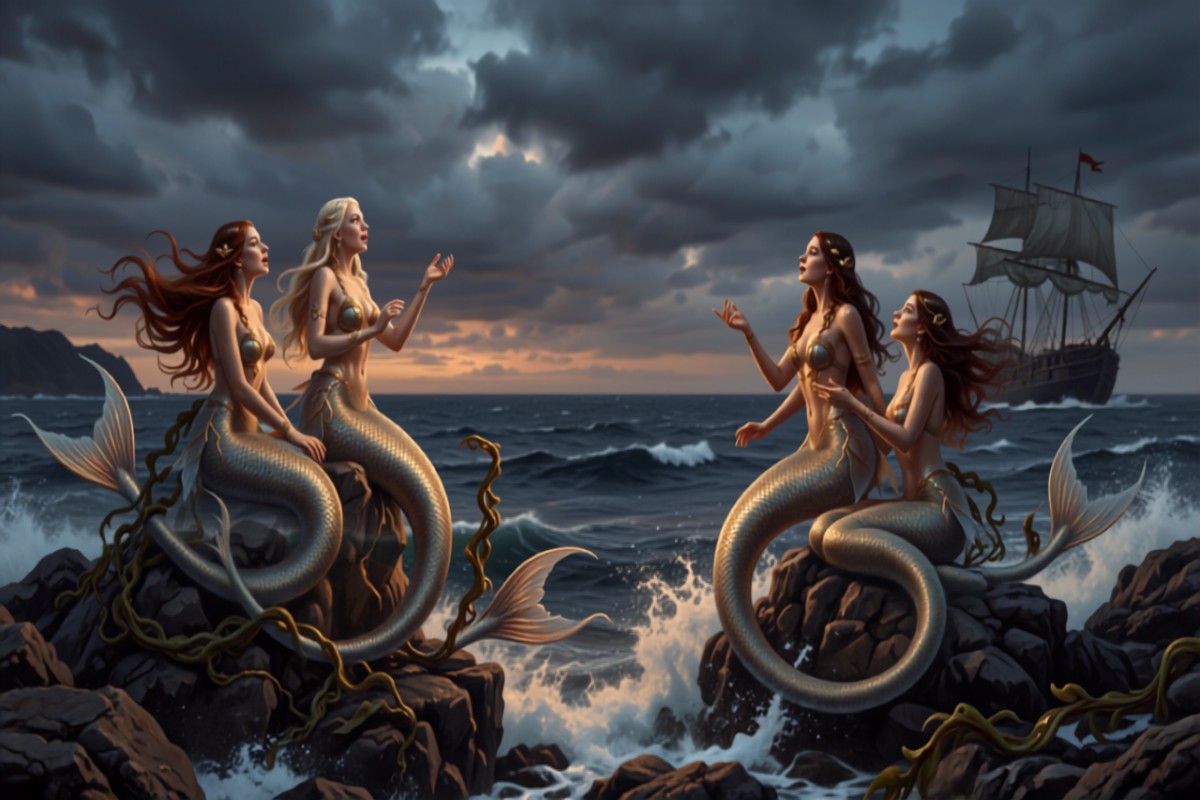
Quick answer: Sirens are dangerous mythical creatures of Greek mythology whose enchanting song caused sailors to steer their ships straight into coastal rocks, where they wrecked and perished. Originally depicted as half-women, half-birds, their image only later merged with that of the mermaid.
Origin and lineage
According to various versions of the myth, the Sirens were daughters of the river god Achelous and one of the Muses — Melpomene, Terpsichore, or Calliope — which explained their supernatural gift for song and music. According to one tradition, the Sirens were originally companions of the goddess Persephone and received wings from Demeter or Persephone herself in order to search for their friend after she was abducted by Hades — or as punishment for failing to protect her.
Appearance: from bird to mermaid
In archaic Greek tradition, Sirens were depicted as creatures with a bird's body and a woman's head, perched on coastal rocks — an image well documented in vase painting of the sixth and fifth centuries BCE. Only in late antiquity and the medieval period did the image of the Siren begin to merge with that of the mermaid, a half-woman, half-fish creature, and in modern popular culture these two distinct mythological beings are often confused or combined into one.
The deadly song
The Sirens' main danger lay not in physical strength but in their song — so beautiful and mesmerizing that sailors who heard it forgot everything and steered their ships straight onto the rocks, where they perished in shipwrecks, or threw themselves into the sea and drowned. The island of the Sirens, according to tradition, was surrounded by the bones and decaying bodies of previous victims — a grim warning that nonetheless could not stop enchanted sailors.
Odysseus and the trick with wax
The most famous encounter with the Sirens is described in Homer's Odyssey. The sorceress Circe warned Odysseus of the danger and suggested a way to avoid it: he ordered his crew to plug their ears with wax so no one would hear the song, while he himself was tied firmly to the ship's mast, wanting to hear the Sirens' song while remaining safe. As the ship sailed past the island, Odysseus, hearing the mesmerizing song, desperately struggled to break free and begged to be untied, but the crew, following orders, only tightened the ropes further until the danger had passed.
The Sirens and the Argonauts
In the myth of the Argonauts, the crew of the ship Argo also encountered the Sirens. This time salvation came through the musician Orpheus, who, upon hearing the first notes of the Sirens' song, played such a beautiful and powerful melody on his lyre that he drowned out their voices, and only one sailor, Butes, could not resist and leapt into the water, but was saved by the goddess Aphrodite.
The symbolic meaning of the myth
The myth of the Sirens is traditionally interpreted as a warning against temptations that distract a person from a rational goal and lead to ruin — a metaphor for temptation against which willpower alone is powerless without external protection or discipline. This is why the expression "the call of the Sirens" entered many languages to denote a dangerously attractive but ruinous temptation, and the word "siren" itself became the name for a sound-signaling device that warns of danger.
Sirens in modern culture
The image of Sirens is widely used in modern popular culture — from the Starbucks coffee chain logo depicting a twin-tailed siren, to countless films, books, and video games where Sirens appear as dangerous yet alluring female characters combining beauty and threat. In psychology and literary criticism, the term "siren call" is used as a metaphor for describing irrational, destructive attraction against better judgment.
Frequently asked questions
Are Sirens mermaids?
Not originally: in ancient Greek tradition, Sirens were depicted as half-women, half-birds, not half-fish. The merging with the mermaid image happened much later, in the medieval period, and today the two images are often confused.
Why did Odysseus want to hear the Sirens' song despite knowing the danger?
Odysseus was driven by curiosity and a thirst for knowledge — he wanted to experience something unavailable to ordinary mortals, but he took precautions by having himself tied to the mast so he would be physically unable to steer the ship toward the rocks.
How many Sirens were there according to the myth?
The number of Sirens varies across sources — from two to five, sometimes more; the most commonly mentioned names are Parthenope, Ligeia, and Leucosia, though no single canonical list exists.
Similar articles
Ladon: The Hundred-Headed Dragon of the Golden Apples
Ladon is a hundred-headed dragon of Greek mythology who guarded the golden apples of the Hesperides, slain by Heracles during his eleventh labor.
Fafnir: The Dwarf Who Became a Dragon
Fafnir is a figure of Germanic-Norse mythology who transformed into a dragon because of cursed gold and was slain by the hero Sigurd.

The Chimera: Monster of Lion, Goat, and Serpent
The Chimera is a fire-breathing monster of Greek mythology with a lion's body, a goat's head on its back, and a serpent tail, defeated by the hero Bellerophon.