How to Build a Pantheon From Scratch for a Game World
Published: 8/27/2026
Quick answer: A convincing fictional pantheon is almost never built entirely from a blank slate—it relies on structural principles from real mythologies: clear division of domains, power hierarchy, and family or conflict ties between gods. Designers who ignore these principles usually end up with a set of random names lacking the feel of a living religious system.
Domains as the First and Foremost Principle
Real pantheons rarely duplicate functions across gods—Zeus governs sky and authority, Poseidon the sea, Hades the underworld, and this division is intuitively clear to believers. When designing a game pantheon, it's important to avoid overlapping domains: each god should have a clear, recognizable area of responsibility so players instantly grasp their role without lengthy lore explanations.
Hierarchy and Its Breach as a Source of Conflict
Living pantheons are never static—Cronus overthrows Uranus, Zeus overthrows Cronus. Building an original hierarchy into the lore, one that has already been or could be broken, gives designers a ready-made source of plot conflicts: uprisings by younger gods, attempted comebacks by deposed powers, struggles for the throne unfolding during the game's own events.
Family Ties as a Fast-Explanation System for Relationships
Kinship ties between gods (siblings, spouses, children) serve a function similar to family trees in TV series—they let players quickly grasp the emotional context of relationships between characters without lengthy lore text. A conflict between brothers reads intuitively differently than a conflict between arbitrarily connected characters.
Oppositional Pairs of Deities
Many real pantheons are structured around oppositions: order versus chaos, life versus death, culture versus wilderness. Such pairs give designers a ready-made dramatic axis for the game's central plot conflict, while simultaneously simplifying visual and thematic design (color schemes, symbolism, temple architecture).
Local and Regional Variations Within One Pantheon
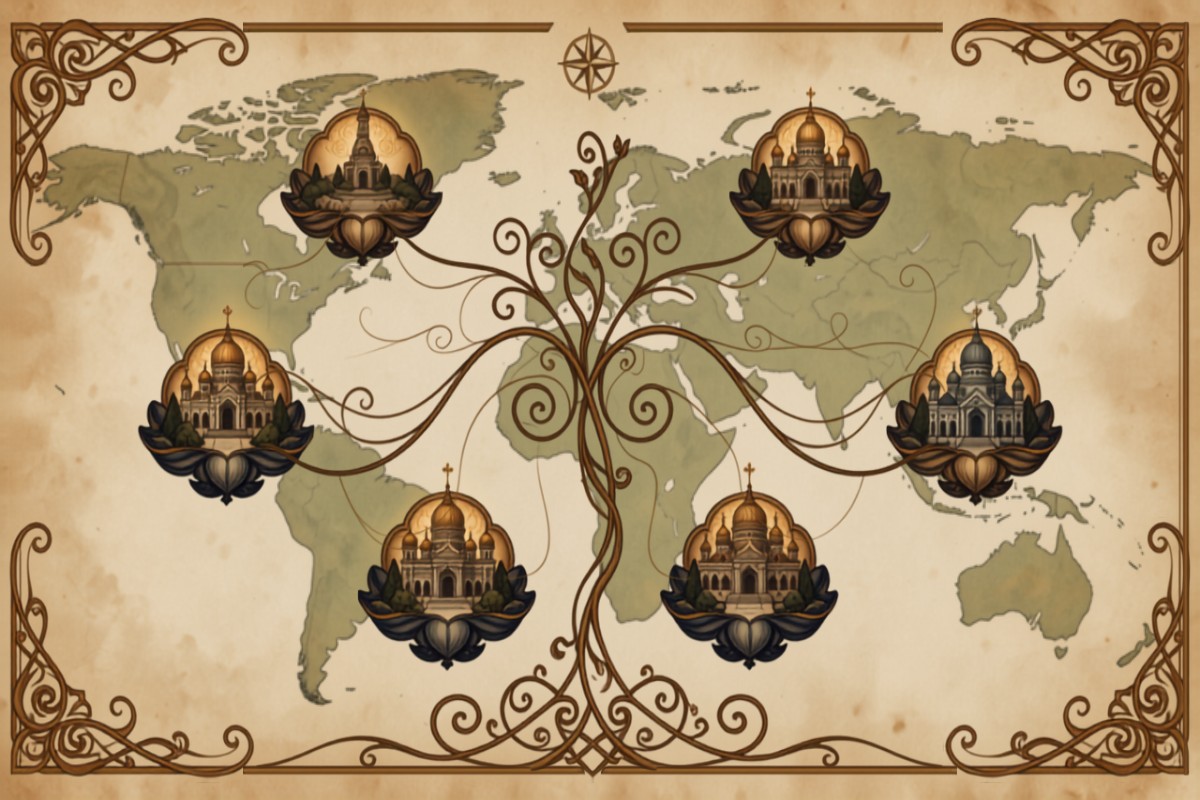
Real mythologies are rarely monolithic—the same god may be worshipped differently across regions (compare Greek Zeus to Roman Jupiter). Introducing regional cult variations of the same deity in a game world adds depth without needing to invent entirely new characters for every location.
The Pantheon as a Source of Factional Game Structure
Beyond purely narrative function, a well-designed pantheon often becomes the basis for a game's faction system: different gods' cults can serve as distinct in-game organizations with their own reputation, quests, and rewards. A real historical precedent—the coexistence of competing temple cults in ancient cities—gives designers a ready-made model for a system where players must balance loyalty to several divine factions at once.
It's also important to consider how a pantheon changes over the course of the game: real mythologies are rarely static—cults rise and decline, syncretize with foreign traditions upon cultural contact (as Egyptian gods merged with Greek ones during the Hellenistic period). Building such dynamics into a game world adds a sense of a living, evolving religious system rather than a museum catalog of static characters.
Frequently Asked Questions
Why is it important to avoid overlapping domains among gods in a game pantheon?
Overlapping domains blur each deity's recognizability, making it harder for players to quickly grasp a character's role without lengthy lore explanations.
How can a god hierarchy be used for plot conflicts?
Building in a history of overthrow or potential rebellion—as in real myths of generational succession among gods—provides a ready-made source of dramatic tension.
Why include regional variations of the same god?
It adds depth to the game world without needing to invent entirely new characters for every region, reflecting real mythological practice.
Similar articles
Titan Bosses: Designing Final Enemies From Mythology
Why mythological titans and giants became the visual and mechanical template for epic video game bosses
Joseph Campbell's Hero's Journey in Video Games
How a universal monomythic structure became a practical tool for game narrative design
Creature Summoning as a Game Mechanic
From spirit-calling in shamanic practice to summoned pets in RPGs — how a mythological ritual became a game system